
The Evolving Specialty Drug Pipeline: What Payers Need to Know in 2026
New FDA approvals, 90 biosimilars and $300K+ therapies are reshaping specialty spend. What payers need to know about the 2026 specialty drug pipeline.
Key takeaways
- The 2026 specialty drug pipeline spans rare disease, oncology, neurology, hematology, autoimmune and metabolic disease, with new mechanisms and expanded indications.
- As of Q3 2026, the FDA has approved 90 biosimilars; 71 have launched and 29 are designated interchangeable.
- Many new branded specialty therapies cost $300,000 to $450,000 a year, and AscellaHealth estimates some pending rare disease therapies at $500,000 to $750,000.
- Single treatments can carry a $2.7M-3.95M one-time cost.
- Route of administration determines pharmacy versus medical benefit coverage and drives total cost of care.
- Payers need flexible coverage, formulary and contracting strategies that adapt as evidence and competition change.
The specialty drug pipeline continues to expand in both size and complexity. Recent FDA approvals span spinal muscular atrophy, multiple myeloma, cancer, IgA nephropathy, thyroid eye disease, autoimmune and metabolic conditions, hemophilia, and type 1 diabetes. Meanwhile, biosimilar competition is growing and existing therapies are reaching new patient populations, reshaping treatment pathways, and specialty drug spending.
For payers, tracking new approvals is only part of the challenge. Understanding their implications for utilization, benefit strategy, access, and total cost of care is equally important.
Which New Specialty Drugs Were Approved in 2026?
The 2026 pipeline reflects continued innovation across rare disease, oncology, neurology, hematology, autoimmune conditions, and metabolic disease, with new mechanisms and expanded treatment options.
Recent approvals illustrate the range of developments:
- Isembyld (apitegromab) targets muscle directly in spinal muscular atrophy and is used alongside existing treatments, potentially adding to treatment costs.
- Zenbexus (iberdomide) introduces a new mechanism for relapsed or refractory multiple myeloma, raising questions about treatment sequencing and combination costs.
- Lipfendra (enlicitide) is the first oral PCSK9 inhibitor, introducing a new option alongside injectable therapies.
- Trutakna (atacicept) targets both BAFF and APRIL in IgA nephropathy, expanding options in a growing treatment category.
- Tryngolza (olezarsen) treats severe hypertriglyceridemia, offering a new approach in a category with limited options.
Potential approvals in Parkinson’s disease, narcolepsy, Gaucher disease type 3, limb-girdle muscular dystrophy, and Sjögren’s disease could further expand treatment options.
For payers, these developments raise important questions: Does a new therapy replace an existing treatment or add to it? Does it offer meaningful clinical advantages? How large is the eligible population, and what coverage criteria are appropriate?
Therapies that supplement existing regimens can increase costs without eliminating current spend. Meanwhile, first-in-class treatments may offer clinical promise but arrive with limited real-world evidence and premium pricing. Monitoring these developments helps plans forecast utilization, assess budget impact, and adapt coverage strategies to different therapies and patient populations.
Existing therapies are also reaching new populations. Hympavzi (marstacimab) has expanded to younger patients and those with inhibitors, while Tzield (teplizumab) received accelerated approval for a new use in children recently diagnosed with stage 3 type 1 diabetes.
How Is Biosimilar Interchangeability Changing in 2026?
As of Q3 2026, the FDA has approved 90 biosimilars, of which 71 have launched and 29 carry an interchangeable designation. Interchangeability allows pharmacy-level substitution without prescriber intervention, subject to state law. Approval, launch, and interchangeability are distinct milestones, each with implications for product selection and potential savings.
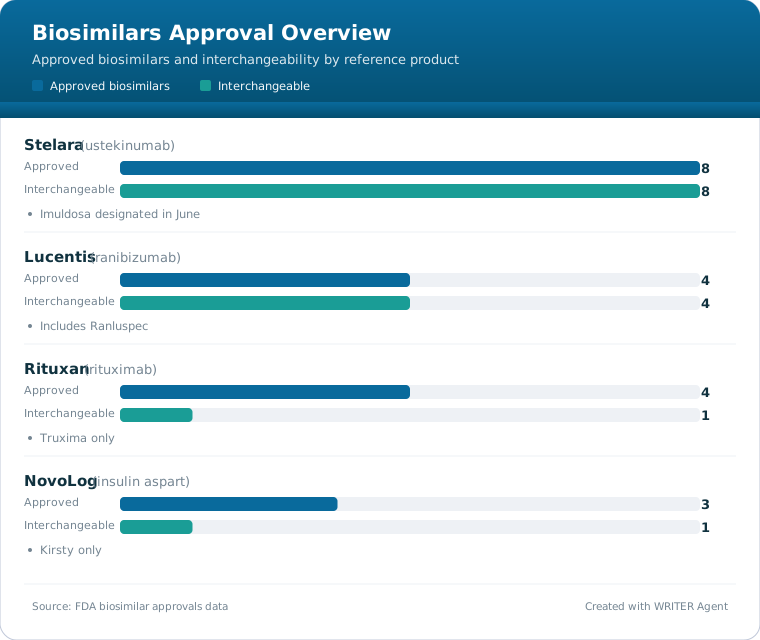
Interchangeability is expanding across established categories. All eight approved Stelara biosimilars are reported to be interchangeable, following Imuldosa’s designation in June. All four Lucentis biosimilars carry the designation, including Ranluspec. By comparison, Truxima is the only one of four rituximab biosimilars with the designation, while Kirsty is the only interchangeable option among three insulin aspart biosimilars.
Biosimilar approvals and interchangeable designations by reference product, as of Q3 2026:
For payers, interchangeability alone does not determine preferred product status or guarantee savings. Formulary placement, manufacturer contracting, provider adoption, distribution channels, and state substitution laws all influence whether competition translates into lower net costs.
The FDA has also proposed changes to interchangeability requirements, while additional biosimilar decisions for Eylea, Simponi, and Orencia are anticipated by the end of 2026. These developments could create further opportunities for price competition, making ongoing assessment of product preferences, contracting, and coverage policies essential to maintaining access while managing costs.
How Much Do New Specialty Drugs Cost?
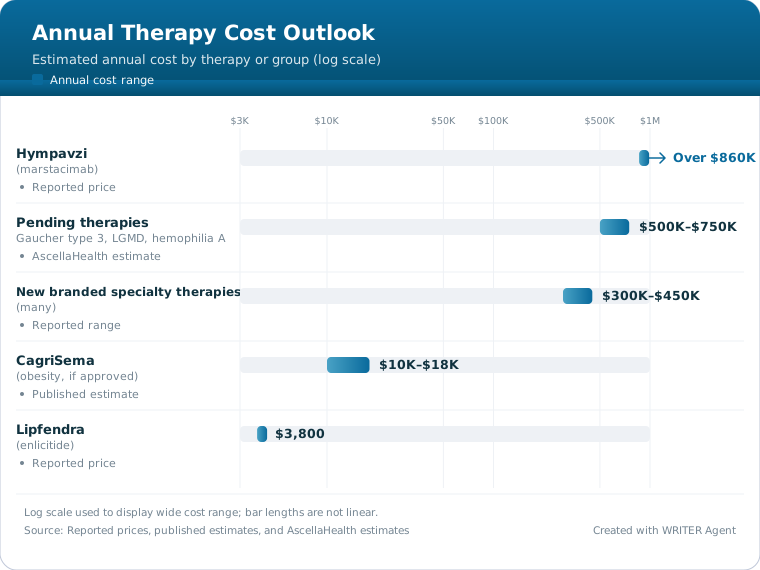
Many new branded specialty therapies carry annual prices of $300,000 to $450,000, while Hympavzi exceeds $860,000 annually. AscellaHealth estimates some pending therapies for Gaucher disease type 3, limb-girdle muscular dystrophy, and hemophilia A could cost $500,000 to $750,000 annually. For small patient populations, even a few additional patients can materially affect budgets.
Costs can compound when new therapies supplement rather than replace existing treatments. Conversely, lower per-patient prices do not always translate into lower overall spending. Lipfendra is priced at $3,800 annually, but as the first oral PCSK9 inhibitor, it could reach a broader population than injectable predecessors. CagriSema, if approved for obesity, could cost $10,000 to $18,000 annually per patient. Across a population potentially numbering in the millions, utilization could become a significant budget driver.
Annual costs of selected new and pending specialty therapies:
Effective cost management requires looking beyond acquisition price to consider eligible populations, expected uptake, treatment duration, combination costs, and potential downstream medical savings. These factors help payers balance access to appropriate treatments with financial sustainability.
How Route of Administration and Site of Care Shape Specialty Drug Costs
Oral medications, self-administered injections, and clinic-based infusions carry different implications for benefit design and spending. Route of administration influences pharmacy versus medical benefit coverage, site of care, administration expenses, monitoring, and patient support.
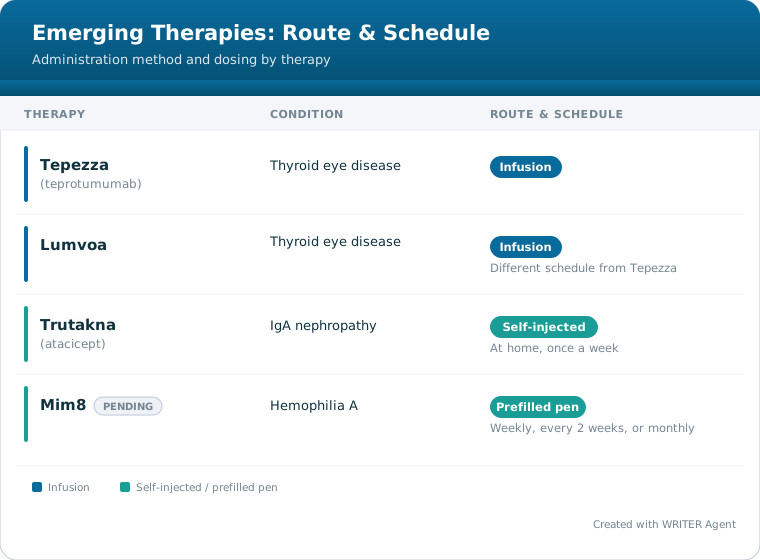
Differences can be significant even within the same treatment category. Lumvoa and Tepezza (teprotumumab) have different infusion schedules for thyroid eye disease, while Trutakna is self-injected at home weekly. The pending hemophilia A therapy Mim8 could offer weekly, every-two-week, or monthly dosing through a prefilled pen.
How selected therapies are administered:
For payers, acquisition price is only part of the equation. Administration, site of care, patient convenience, and coordination between pharmacy and medical benefits all influence total cost and treatment experience. Benefit strategies tailored to the therapy and delivery channel can help identify savings without creating unnecessary barriers to care.
Where Specialty Drug Competition Is Increasing
New therapies are intensifying competition in established categories, including IgA nephropathy, hemophilia, thyroid eye disease, and obesity. Povetacicept and Mim8 could introduce additional treatment options, while Lumvoa joins Tepezza in thyroid eye disease and CagriSema could expand the obesity treatment landscape.
More options do not automatically mean better value. Payers must evaluate comparative clinical evidence, patient eligibility, dosing, treatment burden, net pricing, and potential effects on total cost of care to refine formulary, coverage, and contracting strategies as the market evolves.
Preparing Your Specialty Benefit Strategy for What Comes Next
The specialty drug pipeline is not slowing down. Payers that make pipeline monitoring a continuous discipline will be better positioned to anticipate financial impact, adapt benefit strategies, and support access to therapies that deliver meaningful clinical value. Turning emerging evidence into action requires coordinated decisions and the flexibility to respond as clinical and financial priorities evolve.
AscellaHealth’s quarterly Specialty and Rare Pipeline Digest tracks approvals, pending decisions, and biosimilar developments that may affect payer spending, drawing on more than 15 years of specialty pharmacy experience. Read the Q3 2026 Specialty and Rare Pipeline Digest.
Frequently Asked Questions
What is the specialty drug pipeline?
The specialty drug pipeline is the set of recently approved and pending high-cost therapies for complex, chronic and rare conditions. In 2026, it spans rare disease, oncology, neurology, hematology, autoimmune and metabolic disease, with new mechanisms, expanded indications and growing biosimilar competition all affecting payer spending.
Which specialty drugs were approved in 2026?
Notable 2026 approvals include Isembyld (apitegromab) for spinal muscular atrophy, Zenbexus (iberdomide) for relapsed or refractory multiple myeloma, Lipfendra (enlicitide), an oral PCSK9 inhibitor, Trutakna (atacicept) for IgA nephropathy, and Tryngolza (olezarsen) for severe hypertriglyceridemia.
How many biosimilars has the FDA approved?
As of Q3 2026, the FDA has approved 90 biosimilars. Of those, 71 have launched commercially and 29 carry an interchangeable designation, which allows pharmacy-level substitution without prescriber intervention, subject to state law.
Does an interchangeable biosimilar guarantee savings for payers?
No. Interchangeability allows substitution but does not determine preferred product status or guarantee lower net cost. Formulary placement, manufacturer contracting, provider adoption, distribution channels and state substitution laws all shape whether biosimilar competition produces real savings.
How much do new specialty drugs cost?
Many new branded specialty therapies cost $300,000 to $450,000 a year, and Hympavzi exceeds $860,000 annually. AscellaHealth estimates some pending therapies for Gaucher disease type 3, limb-girdle muscular dystrophy and hemophilia A could cost $500,000 to $750,000 a year.
Why do lower-priced specialty drugs still create budget risk?
Lower-priced therapies can reach very large eligible populations. Lipfendra is priced at $3,800 a year and CagriSema could cost $10,000 to $18,000 a year for obesity if approved, so modest per-patient costs can add up to substantial total spending.
How does route of administration affect specialty drug costs?
Route of administration determines whether a therapy falls under the pharmacy or medical benefit, where care happens, and what administration, monitoring and patient support are needed. A clinic-based infusion and a weekly self-injection at home can carry very different total costs even within the same condition.
How should payers prepare for the specialty drug pipeline?
Payers should track near-term approvals and longer-term shifts in competition, eligible populations and cost structure, then translate that intelligence into flexible coverage criteria, formulary strategy and contracting. Evaluating full regimens, uptake and downstream medical savings, not just acquisition price, gives a truer picture of budget impact.
Sources
- FDA: Biosimilar Product Information
- FDA Purple Book: Database of Licensed Biological Products
- AscellaHealth: Specialty and Rare Pipeline Digest, Q3 2026
- FDA: FDA Approves First Therapy to Target Muscle Loss in Spinal Muscular Atrophy
- CURE: FDA Approves Zenbexus Combination for Patients With Multiple Myeloma
- Fierce Pharma: Lipfendra Becomes World’s First Oral PCSK9 Treatment
- BioSpace: Vera Moves Into Growing Kidney Disease Space With FDA’s Accelerated IgAN Nod
- HCPLive: FDA Approves Olezarsen (Tryngolza) for Severe Hypertriglyceridemia
About AscellaHealth
Healthcare today is more complex than ever—especially when it comes to therapies for people living with rare and chronic conditions. These high-cost, high-impact treatments account for only a small fraction of prescriptions, but they make up the largest and fastest-growing share of total drug spend. As a result, balancing affordability and quality of care remains a significant challenge.
We’re here to change that.
Because at AscellaHealth, we believe that all patients in need should have the ability to access life-changing therapies.
Our Core Beliefs
At AscellaHealth, patients are not just part of the process—they’re why we do what we do. Every solution we build and every partnership we form is designed with the patient in mind.

Patients First, Always.

Balancing Cost and Care.

Better Stakeholder Outcomes.