
The New Payer Challenge: Managing High-Cost, One-Time Gene and Cell Therapies
One-time gene and cell therapies cost up to $3.95 million per treatment. See how payers can weigh value, plan budgets and manage financial risk.
Key takeaways
- One-time gene and cell therapies shift payers from managing recurring specialty spend to planning for a single, concentrated cost.
- Recent therapies cost about $428,000 to $3.95 million per treatment, and many exceed $2 million.
- Payers must weigh upfront cost against durability of benefit, long-term outcomes, avoided future costs and evidence maturity.
- Several recent approvals came through accelerated pathways, so long-term evidence is still emerging.
- Payers that establish evidence review, budget modeling, financial risk management and coordinated pharmacy benefit strategies now will be better positioned to support access while maintaining sustainable benefit strategies.
For years, payers have managed specialty drug spend as a recurring cost: a therapy priced per month or per year, paid for as long as a patient stays on it. The emergence of one-time gene and cell therapies is now changing that model.
A growing number of these treatments are given once and can cost more than $2 million. That shifts the challenge from managing a high-cost therapy over years of use to planning for a single, costly treatment whose clinical and financial implications can last for years, and whose cost lands all at once. It also underscores the need for pharmacy benefit strategies that connect clinical management, financial oversight and operational coordination.
How Much Do One-Time Gene and Cell Therapies Cost?
Recent approvals show how quickly gene and cell therapies are moving from emerging science into everyday benefit decisions:
- Fayuvi (rebisufligene etisparvovec-hopf), the first treatment for Sanfilippo syndrome type A, a rare and fatal childhood disease, costs approximately $3.95 million as a one-time infusion.
- Genglycos (pariglasgene brecaparvovec-opnr), the first therapy to treat the underlying cause of glycogen storage disease type Ia, costs approximately $2.7 million.
- Casgevy (exagamglogene autotemcel) for sickle cell disease and transfusion-dependent beta thalassemia costs approximately $2.2 million. In July, its label expanded to patients as young as 2.
- Tregzi (allogeneic regulatory T cell immunotherapy with HSPC and T cells-vldq), a cell therapy used during stem cell transplant for blood cancers, costs approximately $428,000.
Recent one-time gene and cell therapies at a glance:
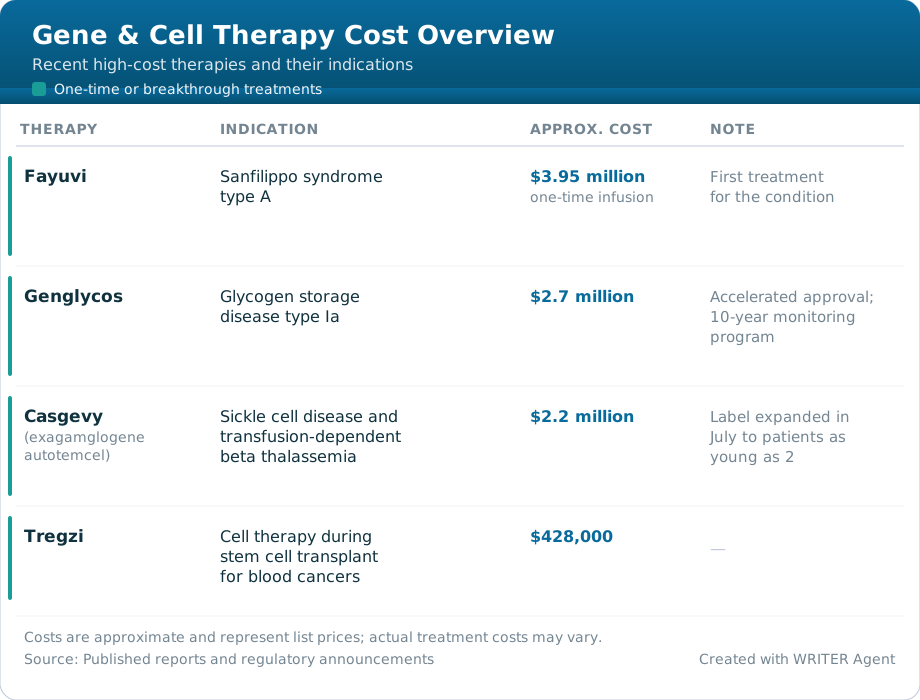
Note: Costs represent approximate U.S. published list prices and may not reflect negotiated discounts, rebates or other contractual arrangements.
While not every one-time therapy costs millions, each does create a concentrated expense tied to a single treatment event rather than spend spread across months or years. For payers, that changes the financial profile, and it raises a question traditional benefit models were not built to answer: how do you budget for a cost that arrives in a single invoice, but whose value unfolds over years?
How Should Payers Weigh the Value of a Gene or Cell Therapy?
The value proposition of a gene or cell therapy is fundamentally different from that of a traditional recurring medication. Payers are evaluating therapies that may alter the course of a disease rather than simply manage it over time. That can upend the expected course of care for a condition, and the cost patterns payers have planned around for years.
That makes the assessment more complicated. Payers have to weigh:
- Upfront cost
- How long the clinical benefit lasts
- Long-term patient outcomes
- Potential avoided future treatment costs
- Maturity of the evidence
For many of these therapies, payers are still waiting on long-term evidence. Some recent approvals, including Genglycos, came through accelerated pathways, meaning continued approval depends on confirmatory data. Genglycos patients will also be followed for 10 years through a disease monitoring program.
That creates a tension at the heart of every coverage decision: payers are being asked to commit significant upfront dollars to therapies whose long-term value is still being established. The cost is certain; the evidence is not.
Can Payers Plan for One-Time Therapy Costs?
How should payers plan for a cost that happens once but has long-term implications? There is no single answer, but the starting point is clear. Gene and cell therapies are changing what specialty benefit management means, and the plans that prepare now will be better positioned to support access to these therapies while keeping their benefit strategies sustainable.
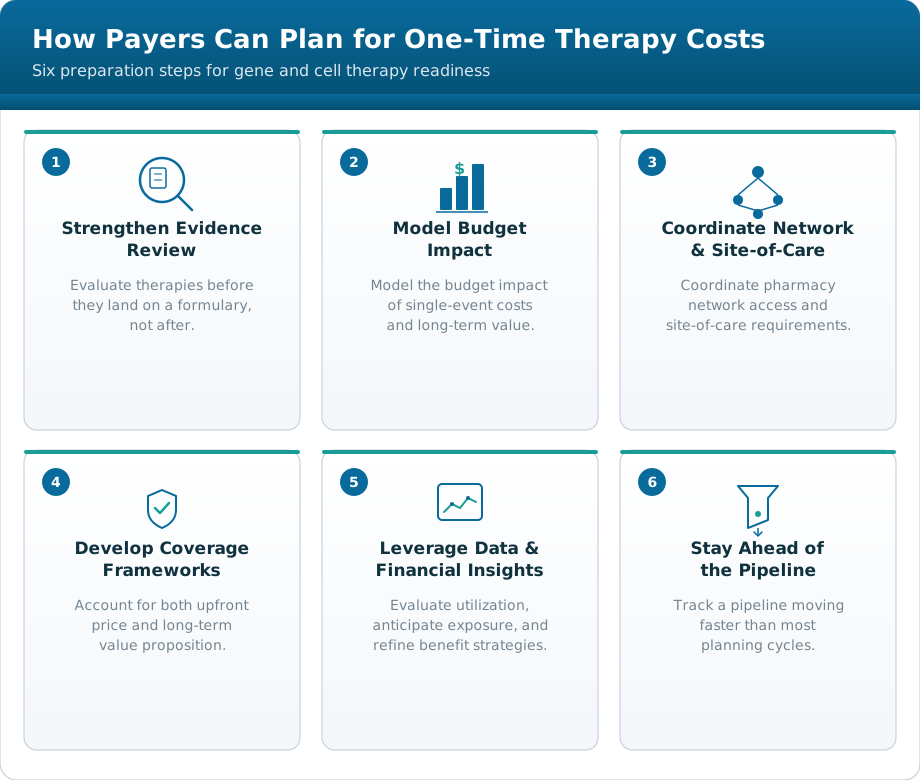
Preparation means building the infrastructure to evaluate these therapies before they land on a formulary, not after. That includes strengthening evidence review processes, modeling the budget impact of single-event costs, coordinating pharmacy network access, site-of-care requirements and patient and provider support, and developing coverage frameworks that account for both the upfront price and the long-term value proposition. Access to meaningful data and financial insights can further help payers evaluate utilization, anticipate exposure and refine benefit strategies. It also means staying ahead of a pipeline that is moving faster than most planning cycles.
What Payment Approaches Can Help Payers Manage Gene Therapy Costs?
Several payment approaches can help payers manage the financial impact of high-cost, one-time therapies.
Outcomes-based agreements tie payment to predefined clinical milestones or patient outcomes, helping align costs with treatment performance. Stop-loss and reinsurance arrangements can help health plans and self-insured employers manage exposure to exceptionally high-cost claims. Installment payments and captive reinsurance arrangements offer additional ways to spread or distribute financial risk.
Each approach has different contractual and administrative considerations. Payers should evaluate how these options align with their benefit design, covered population and budget strategy while accounting for the challenges of tracking long-term outcomes. Transparency into financial arrangements and access to reliable performance data are also important considerations.
Ultimately, managing gene and cell therapy costs requires a proactive approach that combines clinical evaluation, financial planning and appropriate risk-management strategies to balance access with sustainable pharmacy benefit management. Coordinating these elements across pharmacy benefits, patient care and financial management can help payers make more informed decisions as the therapy landscape evolves.
Frequently Asked Questions
What are one-time gene and cell therapies?
One-time gene and cell therapies are treatments given once, often as a single infusion, that may alter the course of a disease rather than manage it over time. Unlike recurring specialty drugs priced per month or per year, their full cost arrives in a single treatment event.
How much do gene therapies cost?
Many one-time gene therapies cost more than $2 million. Recent examples include Fayuvi for Sanfilippo syndrome type A at about $3.95 million, Genglycos for glycogen storage disease type Ia at about $2.7 million, and Casgevy for sickle cell disease and transfusion-dependent beta thalassemia at about $2.2 million.
Why are one-time therapies a budget risk for payers?
One-time therapies concentrate cost in a single treatment event instead of spreading it across months or years. Payers must budget for a cost that arrives in one invoice while the clinical value unfolds over years, a pattern traditional benefit models were not built to handle.
What should payers weigh when evaluating a gene or cell therapy?
Payers weigh five factors: the upfront cost, how long the clinical benefit lasts, long-term patient outcomes, potential avoided future treatment costs, and the maturity of the evidence. Together these determine whether a one-time therapy’s long-term value justifies its upfront price.
What does accelerated approval mean for gene therapy coverage?
Accelerated approval allows certain therapies to reach patients based on early evidence, with confirmatory studies required to verify their clinical benefit. For payers, this means coverage decisions may need to account for uncertainty around long-term outcomes and durability of benefit. Genglycos, for example, received accelerated approval and includes a 10-year patient monitoring program.
How can payers prepare for gene and cell therapies?
Payers can prepare by strengthening evidence review, modeling the budget impact of single-event costs, coordinating site-of-care requirements, and building coverage frameworks that account for both upfront price and long-term value. Tracking the pipeline ahead of planning cycles lets plans act before therapies reach the formulary.
What payment models can help manage gene therapy costs?
Options include outcomes-based agreements, stop-loss and reinsurance arrangements, installment payments and captive reinsurance. Each offers a different approach to managing upfront costs and distributing financial exposure.
AscellaHealth’s quarterly Specialty and Rare Pipeline Digest™ tracks approvals, pending decisions, and cell and gene therapy developments that may affect payer spending, drawing on more than 15 years of specialty pharmacy experience. Read the Q3 2026 Specialty and Rare Pipeline Digest.
Sources
About AscellaHealth
Healthcare today is more complex than ever—especially when it comes to therapies for people living with rare and chronic conditions. These high-cost, high-impact treatments account for only a small fraction of prescriptions, but they make up the largest and fastest-growing share of total drug spend. As a result, balancing affordability and quality of care remains a significant challenge.
We’re here to change that.
Because at AscellaHealth, we believe that all patients in need should have the ability to access life-changing therapies.
Our Core Beliefs
At AscellaHealth, patients are not just part of the process—they’re why we do what we do. Every solution we build and every partnership we form is designed with the patient in mind.

Patients First, Always.

Balancing Cost and Care.

Better Stakeholder Outcomes.